This website for the UK public is developed and funded by AstraZeneca as part of a disease awareness campaign. It is for information only, not for diagnosis. If you are concerned about symptoms, please see your GP or another healthcare professional.

This website for the UK public is developed and funded by AstraZeneca as part of a disease awareness campaign. It is for information only, not for diagnosis. If you are concerned about symptoms, please see your GP or another healthcare professional.

As you learn more about ATTRv amyloidosis, you may come across unfamiliar words. It is normal not to understand them all straight away, especially when learning about a rare condition. If there is anything you are unsure about, speak to your healthcare team, who can help explain it.
On this page, you can read simple definitions of some of these commonly used terms. Words that are defined elsewhere in the glossary are shown in bold.
| Term | Definition |
|---|---|
| Amyloid (a-muh-loyd) deposits |
Clumps of misfolded protein that build up in different parts of the body. This happens when certain proteins, like TTR, fold and stick together. |
| Amyloidosis (a-muh-loy-doh-sis) |
A rare condition where amyloid deposits build up in the body. There are different types of amyloidosis that can affect many organs, causing a wide range of symptoms. |
| ATTR amyloidosis | A type of amyloidosis that is caused by the TTR protein becoming unstable. |
| Cardiomyopathy (kaa-dee-oh-mai-o-puh-thee) |
A general term for diseases that affect the heart and how well it can pump blood around the body. |
| Carpal tunnel syndrome | A condition caused by pressure on a nerve that goes through the wrist. It can cause numbness, tingling and pain in the hands and fingers. |
| Carrier | A person who has a copy of a mutated gene. This change may cause a disease in that person or their children. |
| DNA | The genetic ‘instructions’ that help make a person who they are. 50% of a person’s DNA is inherited from each parent. |
| Echocardiogram (eh-koh-kaa-dee-oh-gram) |
A scan of the heart using soundwaves to create an image. It can help tell healthcare providers how well a person’s heart is working. |
| Gene | A small section of a person’s DNA. |
| Genetic condition | A condition that is caused due to a change in a person’s genes. Many genetic conditions are passed down from parents to their children. |
| Genetic counsellor | A specialist who explains how genes may affect someone’s health. They can support someone who has been diagnosed with a condition like ATTRv amyloidosis. Some of the support they provide includes talking about genetic testing and what the results might mean. |
| Genetic mutation | A change in a person's DNA. A genetic mutation may cause a disease in that person. |
| Genetic testing | A test that looks for changes in a person’s genes. Genetic testing can help diagnose a disease. It can also show if a person or their family have a higher risk of a disease. |
| Hereditary | A condition or trait that can be passed down from parents to their children. These can also be referred to as ‘inherited’ traits or conditions. |
| Hereditary type | In ATTR amyloidosis, ‘hereditary type’ refers to a person inheriting a mutated gene from their parents that can produce unstable TTR. The hereditary type is known as ‘ATTRv amyloidosis‘. The other type of ATTR amyloidosis is ‘wild type’. |
| Inherited | A condition or trait that can be passed down from parents to their children. These can also be referred to as ‘hereditary’ traits or conditions. |
| MRI (magnetic resonance imaging) | A scan that takes detailed pictures of the inside of the body. It can be used to find out what is causing symptoms and diagnose conditions. |
| Neurologist | A doctor that specialises in the brain, spinal cord and nerves. |
| Polyneuropathy (pol-ee-nyoor-op-uh-thee) |
Damage to the nerves across the body's extremities (arms, legs, hands and feet). This can cause symptoms like numbness, pain or weakness in the hands or feet. |
| Progressive | A type of disease that gets worse over time. Many conditions can be managed to delay or stop progression. |
| Protein(s) | Essential 'building blocks' in the body. In a healthy body, proteins fold into specific shapes to allow them to function normally. They are needed for the body to work properly and make up structures like skin and hair. |
| TTR (transthyretin) (trans-thy-ruh-tin) |
A protein that transports vitamin A and a hormone that plays a key role in growth in the blood. This protein is unstable and misfolds in people with ATTRv amyloidosis. |
| V50M mutation | A fault in the TTR gene that can cause the TTR protein to break apart and fold incorrectly. This can cause ATTRv amyloidosis. This mutation is thought to affect people from Portugal at a much higher rate than the general population. |
| Wild type | In ATTR amyloidosis, ‘wild type’ refers to a person developing ATTR amyloidosis as they get older. The TTR protein becomes abnormal over time. The other type of ATTR amyloidosis is ‘hereditary type’ (ATTRv). |
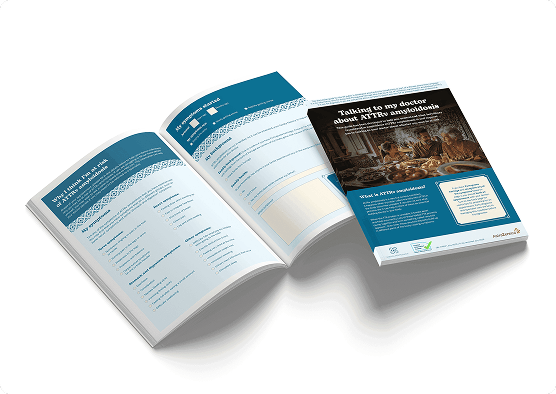
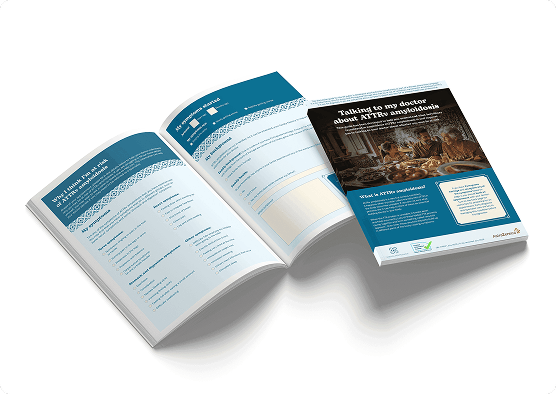
If you think you might be affected by ATTRv amyloidosis and want to book an appointment with your doctor, check out our discussion guide. This resource includes a 'why I think I'm at risk' checklist to support your conversations.
If you have any feedback on this resource, please fill in our questionnaire by clicking here.
GB-77631 | August 2026 | To be reviewed August 2028